Monday, 19 January 2015

Favourite English Words

This isn't really much of a post, more like a list of different links, but while I was writing that (wayyyyy long) post about teachers I happened to come across this list that someone made of his favourite English words. I found that quite interesting so I consulted every student's best friend Google and found a couple of lists of nice, long and sometimes funny English words you can use to show off... ^^ So in case any of you are interested...

This is the list I originally found:
http://www.openculture.com/2014/01/david-foster-wallaces-lists-of-his-favorite-words.html

This is a list I found on Merriam Webster (I LOVE the word "defenestration", I need to remember that one!^^)
http://www.merriam-webster.com/top-ten-lists/top-10-peoples-favorite-words/defenestration.html

These are the 100 most beautiful words in English - apparently:
http://bourbonsoup.com/archives/7554

And this is a list of someone's favourite British slang terms (quite funny, I think...):
http://www.anglotopia.net/british-identity/humor/top-100-most-beautiful-british-slang-words-and-phrases/

Sooo... Maybe you can use those sometime... :)

Sunday, 18 January 2015

Inspiring Teachers

A friend of mine who is currently studying to become a teacher in Vienna recently sent me this playlist of TED talks, all from different (mostly high-school) teachers talking about teaching, different teaching methods and what they think is important when working as an educator. I found some of the things those teachers had to say to be quite interesting, so I thought I'd share the playlist on my blog and summarise some the talks I liked the most. Maybe you'll find them as interesting as I did. Now, I'm not going to summarise all eight talks, so if you'd like to watch those I'm not mentioning here (or if you'd like to watch those I am mentioning for yourselves, which I encourage you to do, even if it's just for listening practice or something, because they are actually quite good talks!), you can do so here: http://www.ted.com/playlists/182/talks_from_inspiring_teachers#

Talks:

1. Rita Pierson - Connect with and encourage your students!

Rita Pierson, who has been an educator for 40 years, talks about the value and importance of human connections and relationships. I really like her approach to teaching kids because she tries to encourage kids as good as she can. She raises the question of how to raise a children's self esteem and their academic achievement at the same time. There's an example in the talk where Mrs. Pierson says, that she once wrote +2 and a smiley face on the test of a kid who had gotten 18 out of 20 questions wrong, because, as she puts it, "Minus 18 sucks all the life out of you. plus 2 says I ain't all bad!". School can be discouraging at times, so I think the way she's trying to focus on the positives is really admirable. At the end of her talk, Mrs. Pierson says, "Every child deserves a champion. An adult who will never give up on them. Who understands the power of connection and insists that they become the best that they can possibly be." I think that's a really nice thought.

2. Christopher Emdin - Engage your audience!

Christopher Emdin's talk is about engaging the people you are trying to teach. He says that the skills taught to aspiring teachers at university are not necessarily the skills that a good teacher needs. In his opinion (and I agree with him on that) learning how to engage an audience, how to be a good storyteller, how to make people interested in what you're saying is by far more important and effective than many of the teaching strategies taught to future educators at university. He also says that you are more likely to learn those skills at rap concerts or in black churches, than you are at university.

3. Tyler DeWitt - Make your lessons fun and use understandable language! (especially in science classes...)

In the third talk a science teacher called Tyler DeWitt talks about how  science text books are written in a way that makes it almost impossible for kids to understand, let alone memorise, the stuff they are supposed to study. He says it's more important that students understand the content of their textbooks, than for that content to be explained in a scientifically completely accurate way. According to him, not having completely accurate knowledge of a subject will not lessen students' chances to ever be successful in science, but not understanding what they're taught in class and, as a consequence, learning to hate the subject, will! I think he does make a valuable point there. If you're taught science in a logical and easily understandable way and you find that the subject interests you, you can still continue studying it and learn everything the scientifically correct and accurate way at university. As far as high-school education is concerned, a basic understanding for the subject, in my opinion, is far more important.

6. Ramsey Musallam - Curiosity comes first!

Ramsey Musallam says he has 3 basic rules for he tries to incorporate in his teaching:
1. Curiosity comes first!
2. Embrace the mess!
3. Practise reflection!
The first of those rules is the one that he highlights most in his talk. He says that "student questions are the seed of real learning" and that one of the most important - if not the most important - things a teacher has to do is to spark the students' curiosity and to encourage them to ask questions.


What I think makes a good teacher:

I think it's hard to say what exactly it is that makes someone a good teacher. There are really strict teachers, that you curse throughout your time in school, but then, in hindsight, appreciate a lot, because they managed to teach you things in a way that you understood and remembered them or because they taught you stuff you actually needed later in life. There are teachers that are really nice and everybody likes, but their teaching just might not be as effective. There are also teachers who you don't like AND teach ineffectively, but we won't talk about those now... The point is, there is no recipe to the perfect teacher, but I think there are three very important things a good educator should have.

Fairness

Nothing will make students lose respect for their teacher faster than said teacher treating them or some of their classmates unfairly. Taking private problems out on students, having favourites, letting whether they like a student or not affect grades, etc., are, in my opinion absolute no-goes for teachers. And yes, teachers aren't robots, we are all human, sometimes your mood affects the way you treat others, I am aware of that! But there are teachers who are able to mask their moods better than others, who at least try to treat their students in a fair way. And I think students respect those kind of teachers a great deal more than someone who lets their private life affect the way he or she treats students or is just generally unfair.

Competence

I think enthusiasm and understanding for their subject is crucial to a teacher's teaching abilities. Students always, ALWAYS notice if the teacher does not actually like their subject; from my experience the best teachers tend to be those who don't just rattle off the lesson they prepared the night before, but actually have more than just superficial knowledge on a subject. Those who genuinely like and are interested in the subject they teach and who therefore have no problem answering more in-depth questions students may ask, because they actually enjoy informing themselves, keeping updated and reading up on their subject. If a teacher is bored by or doesn't actually know all that much about their subject, that will affect their lessons. And not in a positive way. It usually makes students less willing to pay attention or study for that subject. And understandably so, because if even the teacher is bored out of his or her mind by the subject, why should they bother?
A teensy little bit of enthusiasm on the teacher's part doesn't hurt... They don't have to overdo it (in fact, overdoing it might have the opposite effect of what they're trying to achieve...), but from what I've experienced it sure does help if teachers are passionate honestly enthusiastic about their subject and teaching it to others.

Willingness

As a teacher you should be able to work with the people you are trying to teach. If you don't like children, don't become a school teacher. If you can't deal with teaching other adults, well, why make that your job. I can't really speak for adult education here, I don't know too much about that yet, but in school I've come across so many teachers who don't seem like they even want to stand in front of a class and try to deliver information. If you're just gonna be miserable and get frustrated with your students as soon as someone doesn't understand something and dares to ask a question, then, I'm sorry, but you've got the wrong job. Willingness to teach other people is immensely important for a teacher (duh!) and just like enthusiasm, if you lack it, students will be able to pick up on that, no matter how hard you try to disguise it!


But that's just my opinion... I think the only thing we can be certain of is, that, contrary to popular belief, being a teacher can be damn fucking hard!

Saturday, 17 January 2015

Music Snobbery and Why It Annoys Me


Hey everyone!

So, unlike my last post, this one's probably not going to be very long (I thought it was not going to be long. I tried to keep it short. I failed.) particularly earth-shattering.  But I just needed to get this off my chest real quick and I figured, why not do that here? So this post is going to be me venting about some people's need to make others feel bad for the music they listen to. I apologise in advance for any expletives I might use, any confusing turns I might take while rambling my way through this, and any toes I might step on - sorry, I mean no harm! Let's get this party started then, shall we?

Call me naive, but I do actually believe that it's possible to go through life without labelling things based on personal opinions all the time. Hearing people say things like "Wow, that song is complete shit!" - BIG pet peeve of mine. And I try not to get too annoyed, because I KNOW that sentences like that slip sometimes and I KNOW that I've said stuff like that before, too, but... It really does rub me the wrong way. Like, why do you have to say that so negatively? What if the person you're talking to actually really likes this song? The amount of times I've heard people chuckle uncomfortably and mutter quiet "Yeah!"s, because they feel stupid for liking a song their counterpart has just declared utter crap, makes me mad. Can't you just phrase it a bit differently? I don't know, maybe say "I don't like this" instead of "this is shit"! Basically conveys the same message, but isn't as offensive.

Dara O'Briain, Irish comedian
https://www.youtube.com/watch?v=TaQlQjLDsvI at ~1h 4min
Another phrase that I really don't like to hear: "You listen to that?! That's so mainstream!" in an incredulous tone, paired with a condescending look. Luckily, I haven't been on the receiving end of said tone and look all that often, because I can't guarantee my response would have been all that nice...
I don't really understand when and why "mainstream" has become some sort of slur. Correct me if I'm wrong, but to me, mainstream refers to something that a lot of people do or like. Why is that a bad thing? I mean, yeah, don't limit yourself to the stuff you hear on the radio, broaden your horizon, yadda, yadda, yadda... I get that part. I understand that people get fed up with hearing the same ten currently immensely popular songs over and over again. But a song being popular doesn't immediately make it bad. Using the word "mainstream" as a synonym for "not good" or even "shit" has become rather popular and I fail to see why! If enough people like a song for it to be successful, to be played on the radio, to sell a decent amount of copies, it can't be all that shit, now, can it?

What even classifies a "good" song? If a song is really catchy and you can listen to it a lot without it getting old, but it's just not all that musically complex, does that instantly make it a bad song? And is a song, that has the most carefully thought out, poetical lyrics and is near impossible to play live, because it was written by some musical prodigy, really that much superior, if you just can't listen to it, because it gets annoying after a while? Of course you might be able to appreciate that song more on an artistic level, but will artistry alone make you enjoy listening to it?
Now, I am not trying to belittle anything here. I'm not trying to say any one type of song is better than the other, no, that's exactly the opposite of what I'm trying to do. My point is that different people like different things and I don't think anyone should be put down for the things they like just because others might prefer something else. Of course, that doesn't only go for music, but also for movies, books, hobbies, clothes and mostly everything else in life as well. Think about it, does it really concern you, if someone chooses to exclusively listen to top 40 music, if someone prefers metal over alternative rock, or if they've got Beethoven sonatas on repeat? I don't believe it does. To each their own, right? So just go ahead, like the stuff you like and leave others be. And most importantly, don't tell other people their taste in music or whatever is shit, just because you might not like the same things. It only makes people feel bad and I don't think people feeling bad because of something they enjoy should be a thing. So your friend likes folk music and you don't - big fucking deal! You might not agree, everybody is entitled to their own opinion after all, but that doesn't give you the right to tell said friend there's something wrong with their taste in music. What good is that going to do anyway? You won't make them stop liking folk music. The only thing that you might achieve is them not talking to you about the music they listen to anymore.

So, long story short: don't be a dick about other people's taste in music. Actually, no, let me rephrase that! Don't be a dick. Full stop! Repeat that after me, slowly and clearly: Don't. Be. A. Dick. Not going to make you any better, just makes others feel bad. And we don't want people to feel bad, do we? Good. Rant over, class dismissed!


Good night everyone! :)


Thursday, 8 January 2015

Charlie Hebdo


It's only the seventh day of the new year and there has already been what appears to be another terrorist attack. For those of you who don't know what happened: Around noon today two (or three, police are not entirely sure yet) heavily armed men stormed the offices of French magazine Charlie Hebdo in Paris and started shooting. Twelve people died, among them four popular cartoonists and two policemen, several more were injured. The attackers are now on the run.
I could go into more detail about what exactly happened, but there are several news sites that summarise today's tragic events far better than I ever could, so if you're interested I'd recommend you read one (or all) of the following:


(this one's German - sorry...)


(Info on the cartoonists killed and Charlie Hebdo itself)


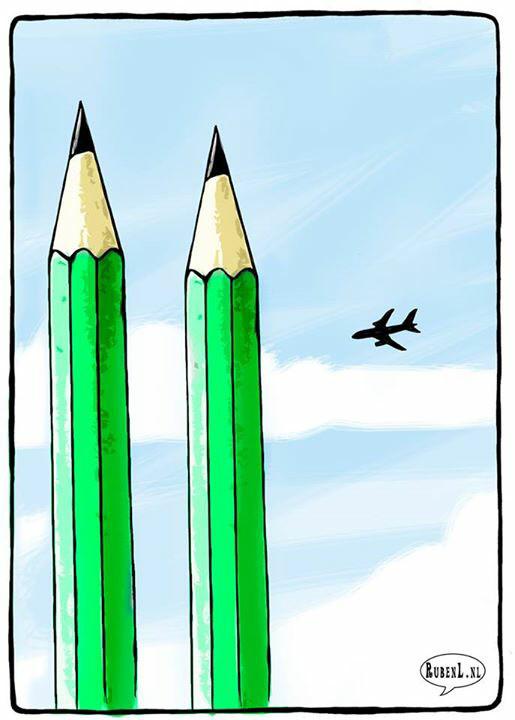
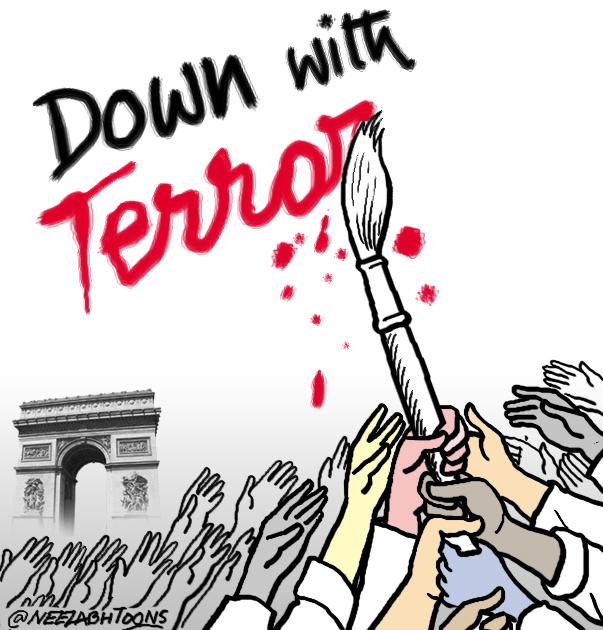
Even though people in and around Paris have been warned about the possibility of further attacks, countless of them are coming together in the streets to proclaim their solidarity with Charlie Hebdo. They are carrying signs saying "Je suis Charlie" (= "I am Charlie") and holding up pens in protest. Not only French people are showing their solidarity. All across Europe people have started to gather to signify their support. #JeSuisCharlie has been trending on Twitter for hours.


What is Charlie Hebdo?

Charlie Hebdo (French for "Charlie weekly") is a French satirical newspaper that quite often covers polemic topics. It has been described as very anti-religious and its controversial cartoons have made headlines in the past. A couple of years ago Charlie Hebdo was victim of terrorist threats and an arson attack to their offices after the magazine published cartoons of the Muslim prophet Muhammad. Charlie Hebdo and its workers have since been under police protection. Unfortunately that protection has now proven unsuccessful.

Response

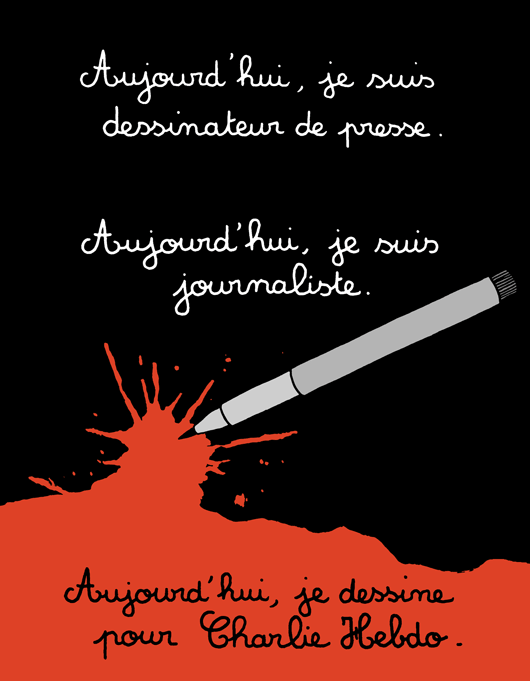
One of the things that struck me most about this whole tragedy was other cartoonists' response. Several cartoons by cartoonists from all over the world have been published since the attacks condemning them (in a more or less cynical way).

David Pope, political cartoonist at The Canberra Times, on Twitter: "Can't sleep tonight, thoughts with my French cartooning colleagues, their families and loved ones #CharlieHebdo"

Ruben L. Oppenheimer, Dutch political cartoonist, on Twitter: "#CharlieHebdo"

Jean Jullien, French graphic designer living in London, on Twitter: "I am devastated by what just happened in France. #CharlieHebdo"

Neelabh Banerjee, Indian cartoonist and illustrator, on Twitter: "Horrible attack. Cartoonists accross the world are uniting against bloodshed and violence."

Nate Beeler, US-American editorial cartoonist for The Columbus Dispatch, on Twitter: "RIP #CharlieHebdo cartoonists. My toon from 2010:"

Bernardo Erlich, Argentinian cartoonist for Revista VIVA, Clarín, on Twitter: "Atentado a Charlie Hebdo." (Attack on Charlie Hebdo.); [The cartoon says: "The world has become so serious that humour is a risky profession."]

Martin Vidberg, French cartoonist, on Twitter: "Comment dessiner aujourd'hui? Comment ne pas dessiner aujourd'hui?" (How to draw today? How not to draw today?); [Cartoon: "Today, I am a press cartoonist. Today, I am a journalist. Today I draw for Charlie Hebdo."]

Francisco J. Olea, Chilean illustrator, on Twitter: "#CharlieHebdo"; ["Grab your weapons, mates!"]

Those are just a few examples of international cartoonists' reactions, that I found on here: http://www.buzzfeed.com/ryanhatesthis/heartbreaking-cartoons-from-artists-in-response-to-the-ch?bffb&utm_term=4ldqpgp#.ev6RLNl4x

Irony at its worst

This is one of the cartoons that was (supposed to be??) published in today's issue of Charlie Hebdo. It was drawn by Stéphane Charbonnier aka "Charb", editor at Charlie Hebdo and one of the cartoonists killed in the shooting.


Roughly translated, the cartoon says: "Still no attacks in France. - Wait! We still have time until the end of January to give our best wishes/wish a Happy New Year."


What people shouldn't forget

Carlos Latuff, Brasilian political cartoonist, on Twitter: "Please RT! #CharlieHebdo attack has another victim! Via @MiddleEastMnt #ParisShooting"
After the shooting, eye witnesses reported, that they had overheard the shooters shouting things like "Allah is Great!" or "We have avenged the Prophet Muhammad!", which lead to the conclusion that the attackers must have been fundamentalist Islamists. What happened in Paris today is a tragedy. As provoking and controversial some of Charlie Hebdo's cartoons and/or articles might have been, going ahead and shooting people wasn't warranted. I don't think killing people is EVER warranted.
Which is why things like "#KillAllMuslims" trending on Twitter, to me, are almost as disgusting as the shooting itself.
I am not in any way trying to justify the attacks. They can't be justified. They were wrong and just plain horrible. But the fact that people are now trying to use today's events as an argument in their tirades against Muslims and Islam worries me. There is a significant difference between Muslims and Islamic fundamentalists. And while condemning what those two (three?? we still don't know) men did is perfectly understandable and valid, condemning an entire group of people along with them, just because they happen to belong to a certain religion, isn't.
Just try to remember that, even in the face of tragedies like the Charlie Hebdo shooting.

Monday, 5 January 2015

Good blog

We were asked to write about what, to us, is a good blog a while ago in class. I've kind of been trying to put off doing this task as long as possible, because I find it rather difficult to pinpoint exactly what makes me like a blog. Frankly, I don't think it's possible for me to describe THE good blog. There are so many things to consider, so many different possibilities of how to design or structure your blog, that, thrown together, can either work perfectly well or not at all. Plus, the elements of a good blog not only depend on individual taste, but, at least in my case, also on the mood of the reader. Which is why I am not able to create any sort of guideline on how to set up a good blog, but I will still try to give you a brief overview of what I generally like and dislike on a blog.


Layout

The first thing I notice on a blog is - obviously - its layout. For me personally, structure and clarity are really important. Colourful, sparkly backgrounds, pretty, curved fonts and lots of animations may appeal to some people, but most of the time I find them a bit annoying. If I open a page and I'm immediately blinded by flashy images I am usually more likely to just close it again and move on to a different blog than to further explore the content, as good as it might be. Which doesn't mean I need blogs to be impeccably neat and boring, and lack personality. I'm just not the biggest fan of visual overload, is all.


Content

I don't know what kind of content a blog is supposed to have for me to deem it good. It depends on my mood on what I'm looking for, I suppose... My favourite blogs tend to be those who feature various different (some might say random) topics. With those you never know what to expect, which kind of keeps them interesting, I guess.


Music

I'm not entirely sure if every type of blog has this feature, but on some blogs it is possible to make a playlist and have music play in the background. Now that can be nice and interesting, even helpful, since you might come across songs you quite like and wouldn't normally have listened to. Most of the time I just turn it off, though. Especially if the playlist in question only includes five songs that are played over and over again. Kind of gets repetitive after a while.


Pictures

Pictures are a good way to make a blog more appealing to readers. They can, for example, make long blog entries seem shorter and more interesting. Readers might sometimes be scared off by too long passages of text, because they are too lazy to read them (unless they are really interested in the topics said passages are about...).
Pictures can also help the author of the blog get their point across. A lot of the time what you are trying to say is summed up infinitely better by a simple picture than by lengthy explanations on your part. Often a picture really is worth a thousand words...


Subheadings

Subheadings have a similar effect as pictures. They make especially long posts more appealing and easier to read, help readers find the parts of the blog they are particularly interested in and help you structure your post in a clearer, more comprehensible way.


All of that said, the most important thing about blogs and blogging (if it is a personal blog and not some sort of professional one, at least) is, of course, that you do it for yourself. If you like to adorn your blog with all things colourful, glittery and flashy - by all means, do! If you like having music play in the background - go ahead! If the one and only thing you want to post on your blog is knock-knock jokes - nobody's stopping you! Create your blog whichever way you like! You're the one who creates the blog, so you and your personality are its essence, the thing that makes your blog unique. I like to look at blogs at some sort of shared diaries. A form of expressing oneself. And everybody has their own way of expressing themselves after all...